
Things to Know Before Your First Yoga Class
As Yoga school owners for over 20 years, we often hear the same questions from our newbies looking to start a Yoga practice. You know… the basics.
- What do we wear?
- What class do I start with?
- Is there anything I should know before I come to class?
Simple questions that help us go from nervous to confident.
Here, we will review those questions so that you can walk into your first class with confidence that you are prepared and ready to flow on your mat. Let’s go!
1. What class should I start with?
For most beginners, this is the first question. They pick up a schedule, see many options, and encounter many new terms they haven’t seen before or haven’t seen in a long time. Here is a breakdown of most class titles to give you a level of confidence that you are joining the right class for where you are today.
- Gentle: Beginner-friendly class offering a slower pace and more detailed instruction. It is great for someone who hasn’t been very active recently or for someone looking for a slower-paced class.
- Level 1: Beginner-friendly class that is great for someone new to Yoga, looking to build a Yoga practice, or an experienced yogi seeking a foundational class. Expect more movement than a gentle practice. By “more movement,” we mean moving from standing to floor poses multiple times throughout class. This builds strength and endurance.
- Level 2: NOT beginner-friendly. A Level 2 class builds on the knowledge base and strength that you have built in your Level 1 classes. Students are led through more advanced versions of Yoga poses and sequences.
- Vinyasa: a fancy Yoga term for ‘flow’. In a Vinyasa class, the student will move from pose to pose, linking movement to breath. Gentle, Level 1, and Level 2 classes are all “Vinyasa” Yoga, meaning that you will move from each pose in a fluid sequence, holding each pose for 1 to 5 breaths.
- Restorative: Beginner-friendly class that utilises props such as bolsters, straps, blankets and sandbags to position the body into poses that lengthen your body through the use of gravity. It is deeply restoring, hence the name. Each pose is held for 5-10 minutes in a calm, relaxing setting. While some restorative classes begin with a gentle, slow-paced flow to open the body, most of the class is spent in resting positions without flowing from pose to pose. Take this class if you are looking to relax and deeply restore your body.
Make sure to arrive at least 10 minutes before class. This makes the transition from your everyday life to your Yoga class easier.
With this being your first class, let the teacher know before class starts so they can address any questions you might have. They will likely give you tips to help you feel more comfortable with the poses the teacher will lead you through.
-
What do I wear?
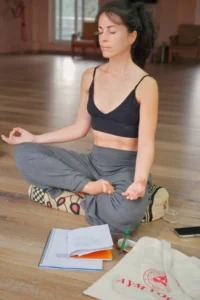 Choose something you can move in that is also comfy. Yoga pants come in all forms: tight like leggings, loose like sweatpants or in between like joggers. Really, any pants that you can move in all directions in are Yoga pants.
For a top, choose something close-fitting. That can be a T-shirt or a tank top. If you are cold-natured, start in layers so you can peel them off as your body temperature rises during class. I often start with a long-sleeve shirt over a tank top. It’s great to have a long-sleeve option during the opening moments of class before the body fully warms up, as well as at the end during relaxation and the final resting pose.
Remember: The only thing that matters about what you wear to Yoga class is that you both feel comfortable in it and that you can move in it. Everything else … let it be.
-
What should I bring?
The Yoga essentials are a mat and a water bottle.
When picking out a Yoga mat, look for one that is thin, has a bit of grip, and comes in a colour that makes you feel happy or relaxed. Whatever feeling you are looking to achieve.
Lastly, we can’t say enough about the importance of hydration. Keep a water bottle with you to stay hydrated throughout the session, and replenish fluids after the class.
-
What do I do when I step into class?
The first thing you will want to do is take a deep breath and smile. YOU MADE IT!
The hardest part of Yoga is getting yourself there!
After that smile, let your teacher know it is your first class and ask any questions you have. The teacher will point you to where to roll out your mat and which props to grab from the prop wall. Some classes will use many props, and others will use none at all, so it’s always good to ask. I also suggest checking your teacher’s mat to see which props they have pulled out. That is also a good indication of what props you will need.
From there, have a seat on your mat and relax because the fun is just about to begin!
-
The Most Important Guidance to Consider
The best time to start is now.
I remember my first class very well. I was intimidated by everything. I was nervous that I wouldn’t know what to do, where to place my mat, or if I looked like a beginner.
What I didn’t know was that everyone in that room was rooting for me to win. The people who surrounded me were there to feel better in their own bodies, not to judge mine.
The most important part of your Yoga practice is just that it is a practice. Stepping on your mat is the first step toward a beautiful journey of self-discovery, feeling comfortable in your body and more relaxed in your mind. Everyone is rooting for you.
One thing we know for certain is that no one walks out of a Yoga session wishing they had never come. Now that you have read this, you will also walk into your Yoga class feeling confident and ready for the experience!
Want to learn more about Yoga as a beginner? Join us for our Yoga for Beginners Course. Sign up today!