
HATHA YOGA IN GOA
A BEGINNER’S GUIDE
The AYM Yoga School specialises in Hatha Yoga in Goa. In addition, we offer company yoga, group yoga classes, and outdoor yoga near Arambol Beach. The courses we provide are as follows: Click on any image to know more about the course
Yoga for Lifestyle & Healing
HATHA YOGA IN GOA
The term Hatha Yoga refers to the physical practice of Yoga with emphasis on safety and alignment. This is a slower-paced class that teaches you how to align your body and work with the breath, with less flow and easier transitions. Great for beginners; suitable for all ages and body types. This program is designed to be gentle and relaxing, yet empowering, strengthening and informative. Hatha Yoga is the term used for the physical branch of Yoga that leads one to the fruits of the practice, namely Raja Yoga. The word Hatha is a construct of the words “ha” (meaning sun/masculine energy) and “tha” (moon/feminine principle), both of which inhabit one’s body.
HATHA YOGA | हठयोग
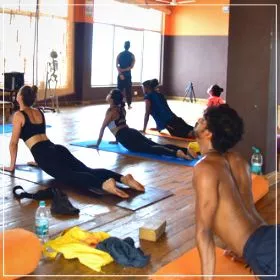 Hatha yoga is a specific yoga system introduced by Yogi Swatmarama in 15th century India. The name Hatha is compounded by Ha and Tha, respectively, meaning the sun and the moon.
Hatha yoga is a preparatory stage in cleansing your physical body that keeps your body in shape through practicing a higher level of meditation. Hatha yoga is a powerful practice for purifying the body, the mind, and the soul. This type of Yoga also follows the same principles as Raja yoga.
When people in the Western world talk about Yoga in general, they often mean hatha yoga, as it is practiced quite widely to take care of physical and mental health and is one of the best-known yoga types. Traditional Hatha Yoga follows a relatively predetermined yogic path as it is quite disciplined in physical exercises and meditation. The Hatha Yoga practiced in the Western world usually included postures and movements.
Hatha yoga focuses on the physical culture, similar to Raja yoga. Both yoga types can be referred to as the Ashtanga yoga, consisting of eight parts concentrating on doing different poses.
Hatha Yoga in Goa – What is a Hatha Yoga Class like?
Hatha yoga (in Goa) is a category that generally comes to mind when you think of Yoga in regular terms. The exercise involves body, breath, and soul, and classes are often forty-five minutes to ninety minutes of yoga poses, Pranayama, and meditation.
Below is a list of what to expect in a Hatha class
- Pranayama (Breathing) & Meditation: Hatha Yoga classes typically start with breathing and meditation. The teacher will guide you through this session to focus the mind, identify the breath, and construct space for movement.
- Warm-Ups: After the breathing and meditation session, a sequence of traditional Surya Namaskar (sun salutations) is used to heal the body.
- The Poses: A combination of standing and seated poses will explore in the next session. Yoga poses such as Tadasana (Mountain Pose), Vrikshasana (tree pose), Uttanasana (Standing Forward Bend), and Adho Mukha Svanasana (Downward Facing Dog) are frequent. The sequence of postures is varied for each class.
- Light, Sound & Room Temperature: Hatha Yoga classes can be held at room temperature with soft light and soft music to get students in a meditative state.
Health Benefits of Hatha Yoga in Goa
Here are some of the striking benefits of doing Hatha Yoga
- Stress management: Yoga improves psychological or physical stress in twelve studies reviewed, according to the National Center for Complementary and Integrative Health (NCCIH).
- Emotional health: Hatha Yoga has a decisive positive impact on mental health and improves flexibility or healthy psychological fitness.
- Depression and Anxiety: Analysis shows that Hatha Yoga can assist in relieving common depressive and anxiety symptoms.
- Sleeping disorders: Several kinds of research reviewed by government health organizations have found that Hatha Yoga can improve sleep quality and duration.
Although, many kinds of researches and studies have found that that hatha yoga can be helpful in menopause, healthy living, balance, multiple sclerosis, back pain, neck pain, arthritis, and fibromyalgia.
HATHA YOGA IN INDIA
Teaching yoga is yet another form of personal practice. Becoming a teacher with depth and effectiveness means shifting from teaching as an expert to sharing. It is the sharing of a teacher’s firsthand life-changing experience with technique and philosophy rather than the relaying of technique and philosophy.
Hatha Yoga in Goa is designed to guide participants towards practical and real personal integration. A teacher must demonstrate precision and safety in teaching poses and in understanding what is physically and biochemically occurring during mat practice. Offering yoga to others is about guiding others into their own firsthand experiences that encourage relaxation, relieve stress and foster a more profound and more continual state of contented happiness.
THE BENEFITS OF HATHA YOGA INCLUDE:
- Improved flexibility and increased muscle joint mobility.
- Strengthening, toning, and building muscles as flexibility improves.
- Correcting lousy posture by strengthening the spine and spinal muscles, alleviating back pain, and promoting balance and grace.
- Relieving muscular-skeletal conditions such as bad knees, neck issues, tight shoulders, swayback, and scoliosis.
- Increasing stamina and stimulating the endocrine system’s glands can improve digestion and elimination, resulting in better energy levels.
- Enhancing circulation, improving heart conditions, correcting breathing disorders, and boosting immune responses.
- Contributing to reduced cholesterol and blood sugar levels and supporting weight loss efforts.
Please note that while these benefits are commonly associated with Hatha Yoga, consulting with a qualified yoga instructor or healthcare professional is always recommended for personalized guidance and advice.
Hatha Yoga:
For some students of Hatha Yoga, there comes a time when practising once or twice a week is no longer enough. There is a need to look more deeply to gain greater clarity and understanding of the essence of Yoga. Be it to transition to another style, explore the Yogic philosophy, or pass on the benefits and gifts Hatha Yoga brings to them. For these Yogins/Yoginis, Yoga 4 Peace has developed a program that does just that. It takes one to the next level. They emerge with a new perspective on Yoga and a clear understanding of their place and role in this beautiful tradition.
The cost is $1199 for the 23-day residential Hatha Yoga program. This training program is registered with “The Yoga Alliance”, the governing body for Hatha Yoga in the United States and the entire world. You will receive an RYT 200-hour level certification from The Yoga Alliance when you complete it. You will be added to the Alliance’s list of Registered Instructors.
The Hatha yoga definition is as follows:
Hatha yoga is the same branch of yoga Tree, The [Hatha] means “force,” and thus it suggests or calls attention to indirectly to the systematic physical techniques of Yoga. In our country, Indian Hatha yoga is associated with popular culture with the ‘joys’ of the Natha Sampradaya via its legendary founder Matsyendranath.
Matsyendranath, also known as the Minamata or Minapa in Tibet, is a saint in both Buddhist and Hindu Tantric and Hatha yoga schools. Therefore, SUBSEQUENTLY, the Yoga goa relates Yoga Hatha to the Dashanami Sampradaya and the mystical parent of Dattatreya.
According to the Dattatreya Yoga Sastra:
There are two Hatha Yoga styles: one is practised according to Yajnavalkya, including the 8 Limbs of Ashtanga Yoga, and the other is practised according to Kapila and the 8 Mudras. In this article, the earliest content explaining Hatha Yoga, the Amrtasiddhi, comes from a Tantric Buddhist milieu.
The oldest texts to use the real verbiage of hatha are also Vajrayana Buddhist.
In the 20th century, Hatha Yoga, especially the asanas (Yoga body postures), gained popularity as a form of physical exercise. Therefore, it is now colloquially referred to as “Yoga.”